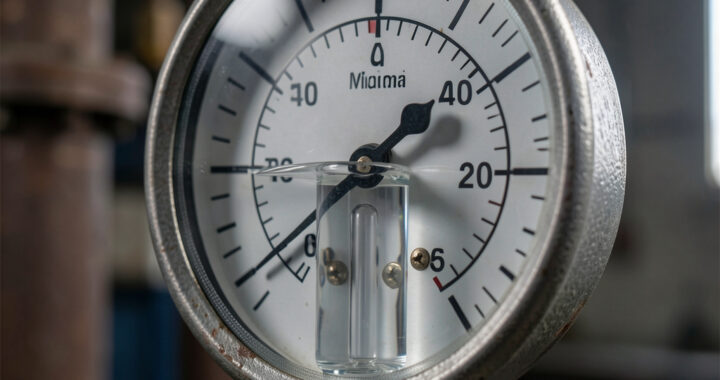
20 Inches of Water Column to PSI: Conversion Explained

If a gauge, spec sheet, or manufacturer’s manual just threw a number at you in inches of water column and you need it in pounds per square inch, you’ve landed in the right spot. Twenty inches of water column comes out to roughly 0.722 psi. That’s a small number compared to what most people picture when they hear the word pressure, and there’s a good reason for the gap. Water column measurements exist specifically for pressures too small for a standard psi gauge to read with any accuracy. Below is the exact formula, a full conversion table for the values you’re most likely to run into, and a rundown of where this unit actually shows up on the job.
Disclosure: This page may contain affiliate links. Please see our affiliate disclaimer for more information.
What Is Inches of Water Column, and Why Does It Exist?
Inches of water column, sometimes written as WC, w.c., in. H2O, or just “inches of water,” measures pressure by the height of a column of water that a given force can push. Picture a U-shaped glass tube filled halfway with water. Apply pressure to one leg of the tube and the water drops on that side while rising on the other. The difference in height between the two legs, read in inches, is your pressure reading.
Technicians reach for this unit because plenty of real-world pressures are genuinely small. A typical residential furnace runs natural gas at somewhere between 3.5 and 4 inches of water column right at the appliance. Put that same pressure on a standard 0 to 30 psi gauge built for tires or compressors and the needle won’t move far enough to read. A manometer calibrated in inches of water column gives you a number you can actually work with.
That’s the whole reason the unit has stuck around in an age where most other measurements went metric or digital decades ago. It’s sensitive at the low end, cheap to measure with a basic U-tube, and it matches how gas and air pressure specs have been written for close to a century.
20 Inches of Water Column to PSI
Twenty inches of water column equals approximately 0.722 psi (0.7225 psi carried out to four decimal places). That’s the answer, but the formula behind it is worth knowing so you’re not stuck hunting for a table every time a new value lands on your desk.
The Formula
The conversion relies on a constant tied to the weight of water. One inch of water column equals approximately 0.0361 psi. To convert any water column reading, multiply by that constant:
psi = inches of water column × 0.0361
For 20 inches: 20 × 0.0361 = 0.722 psi.
Going the other direction, 1 psi equals about 27.7 inches of water column. Divide a water column reading by 27.7 and you land on the same answer as multiplying by 0.0361, just approached from the other side.
Why You Might See a Slightly Different Number
Different sources round this constant differently. You might spot 0.03613, 0.036127, or 0.036091 depending on where you look. The variation comes from the temperature at which water’s density was measured. Cold water is denser than warm water, so a column measured at 39.2°F (4°C, the standard NIST and most engineering references use) exerts marginally more pressure than the same column measured at 60°F, which is the reference point some HVAC and gas industry documents use instead.
At 20 inches of water column, the gap between the two standards works out to about 0.001 psi. That’s not enough to matter outside of lab calibration work, and it won’t change which regulator you order or how you read a field gauge.
Full Conversion Table: Inches of Water Column to PSI
Here’s a working reference for common inches of water column readings, calculated using the standard 0.0361273 psi constant.
| Inches of Water Column | PSI |
| 1 | 0.0361 |
| 2 | 0.0723 |
| 3 | 0.1084 |
| 3.5 | 0.1264 |
| 4 | 0.1445 |
| 5 | 0.1806 |
| 6 | 0.2168 |
| 7 | 0.2529 |
| 8 | 0.2890 |
| 9 | 0.3251 |
| 10 | 0.3613 |
| 11 | 0.3974 |
| 12 | 0.4335 |
| 14 | 0.5058 |
| 15 | 0.5419 |
| 20 | 0.7225 |
| 25 | 0.9032 |
| 27.7 | 1.0007 |
| 28 | 1.0116 |
| 30 | 1.0838 |
| 35 | 1.2645 |
| 40 | 1.4451 |
| 50 | 1.8064 |
| 75 | 2.7095 |
| 100 | 3.6127 |
Going the Other Direction: PSI to Inches of Water Column
Sometimes the spec sheet gives you psi and you need water column instead, which is common when you’re cross-referencing a regulator’s outlet rating against a manometer reading. The formula flips:
inches of water column = psi × 27.68
| PSI | Inches of Water Column |
| 0.5 | 13.84 |
| 1 | 27.68 |
| 2 | 55.36 |
| 5 | 138.4 |
| 10 | 276.8 |
| 14.7 (atmospheric) | 406.9 |
That last line is worth sitting with for a second. Standard atmospheric pressure, 14.7 psi, equals a water column almost 34 feet tall. It’s a useful gut check for why psi and inches of water column serve such different jobs. One is built for everyday pressures, the other for pressures so small they’d disappear on a psi gauge entirely.
Where This Conversion Actually Comes Up
Natural Gas and Propane Lines
Appliance manufacturers rate their equipment for gas pressure in inches of water column because the working range is so narrow. Natural gas typically arrives at the appliance around 3.5 to 4 inches of water column, while propane systems usually run higher, somewhere around 10 to 11 inches of water column. Upstream of the regulator, line pressure runs much higher and sometimes gets specified in psi instead, which is exactly when a technician needs to convert between the two to confirm a regulator or test gauge is rated for the right range.
HVAC Duct Static Pressure
Total external static pressure on a residential duct system usually sits somewhere around 0.5 to 0.8 inches of water column. Commercial systems run higher, and techs measure it with a manometer or a magnehelic gauge to catch restricted filters, undersized ductwork, or a blower fighting more resistance than it should. None of these readings would register meaningfully on a psi gauge, which is another reason the low-pressure unit has never gone away.
Boiler and Furnace Draft
Draft pressure inside a chimney or flue is measured in inches of water column too, and it’s often a small negative number rather than a positive one. A slightly negative draft pulls combustion gases up and out of the appliance the way it’s supposed to. Techs checking draft with a manometer need to track both the size and the sign of the reading, since a positive number where a negative one belongs points to a venting problem.
Cleanrooms and Room Pressurization
Facilities that need to keep contaminants out, or keep them contained, track the pressure difference between adjacent rooms in inches of water column. A cleanroom might run at a small positive pressure relative to the hallway outside it, while an isolation room in a hospital runs negative for the opposite reason. These differentials are almost always a fraction of an inch of water column, well below anything a psi gauge could resolve.
How Technicians Actually Measure Inches of Water Column
A few tools handle this measurement in practice:
- U-tube manometer is the simplest option, a clear tube bent into a U and partly filled with water or a lightweight oil. Pressure applied to one side pushes the fluid up the other, and you read the difference directly off a printed scale.
- Digital manometer is the standard tool on most job sites now. It reads pressure electronically and can usually switch between inches of water column, psi, pascals, and other units with a button press, which skips the manual conversion entirely.
- Magnehelic gauge is a dial gauge built for a specific narrow range, like 0 to 1 inch of water column or 0 to 20 inches of water column. Common on HVAC equipment and filter monitoring stations where a fixed, easy-to-read range matters more than flexibility.
Common Mistakes When Converting Water Column to PSI
- Mixing up inches of water with feet of water throws every downstream calculation off by a factor of 12, since a foot of water column equals 12 inches.
- Confusing inches of water (inH2O) with inches of mercury (inHg) is easy to do on an old reference sheet. Mercury is about 13.6 times denser than water, so its constant, roughly 0.491 psi per inch, is nowhere close to the water column figure, and the result lands off by more than tenfold.
- Rounding too early hurts in multi-step work. If you’re converting water column to psi and feeding that number into another formula, carry at least three decimal places until the final step.
- Draft pressure, return-side duct pressure, and room pressurization readings are frequently negative, and dropping the minus sign during a conversion can make a problem look fixed when it isn’t.
Frequently Asked Questions
What is 1 inch of water column in psi?
One inch of water column equals approximately 0.0361 psi.
How many inches of water column equal 1 psi?
About 27.7 inches of water column equal 1 psi.
Is 20 inches of water column a lot of pressure?
Not by psi standards, 20 inches of water column is only about 0.722 psi. Within the world of low-pressure gas and air systems, though, it’s a meaningful reading and sits well above typical residential appliance pressures.
What’s the difference between inches of water column and inches of mercury?
Both measure pressure by the height of a fluid column, but mercury is roughly 13.6 times denser than water. That makes inches of mercury a much heavier unit: 1 inch of mercury equals about 0.491 psi, compared to 0.0361 psi for 1 inch of water.
Can inches of water column readings be negative?
Yes. Negative water column readings show up constantly in draft pressure, return-side duct static pressure, and room pressurization monitoring, anywhere a system is designed to pull rather than push.
Why do gas and HVAC technicians use inches of water column instead of psi?
Because the pressures involved are too small for a standard psi gauge to read with any precision. Inches of water column gives a sensitive, easy-to-read scale for pressures that would barely register as a blip on a 0 to 30 or 0 to 100 psi gauge.
The Number Worth Remembering
Keep the 0.0361 constant somewhere handy, whether that’s a sticky note on a toolbox or a saved note on your phone. It’s the one figure that turns any inches of water column reading, 20 or otherwise, into a psi number you can check against a regulator spec, a gauge rating, or a manufacturer’s chart without guessing.
Content Disclaimer: The information on this page is provided for general educational and informational purposes only. While we aim to keep our content accurate and up to date, errors or omissions may occur. Information, specifications and other details can change, so always verify important information with the manufacturer or another reliable source before making a purchase or taking action.