
How Is Water Pressure Measured? Gauges, Units & Methods Explained

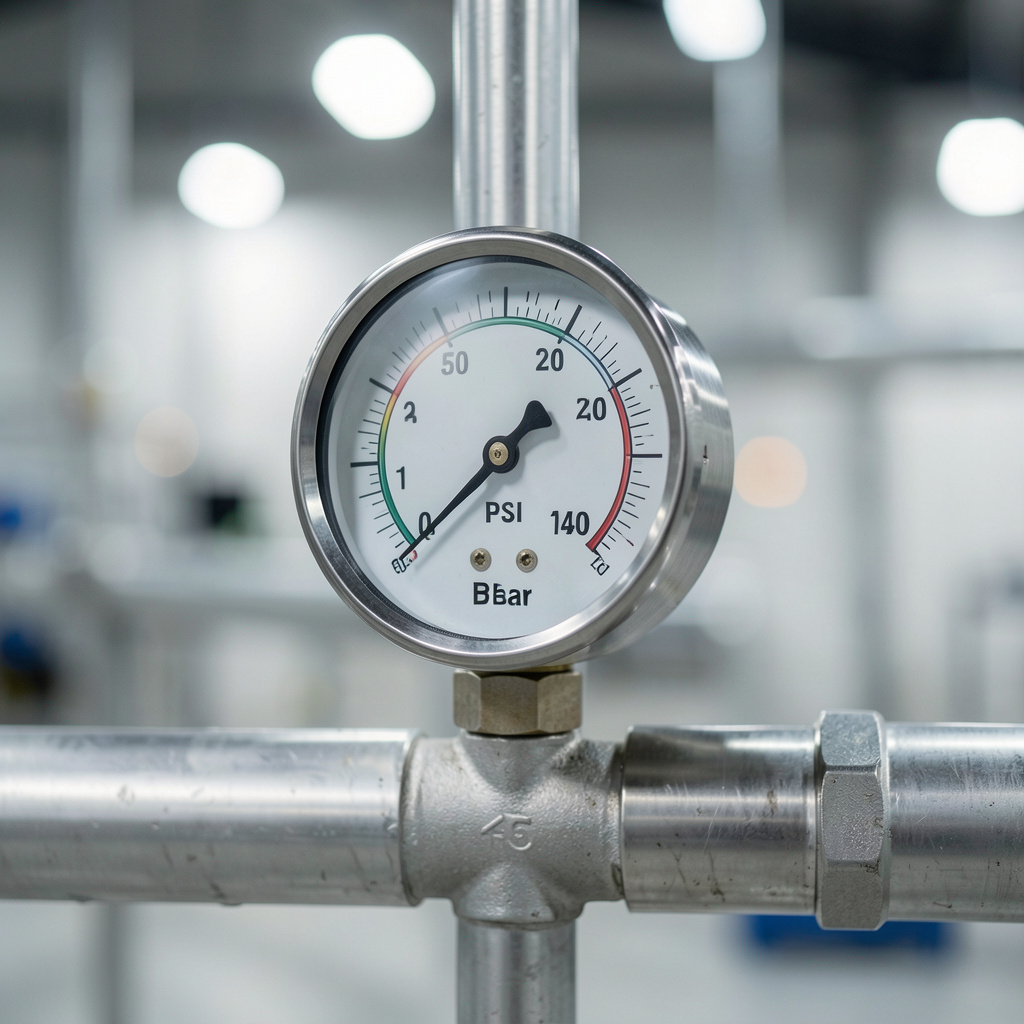
A tank three metres above your shower delivers about 0.3 bar. A tap on a typical mains supply might show 55 psi. A diver at 20 metres is sitting under roughly 3 bar in total. Those numbers look unrelated, but they come from one idea. Whether it’s the pressure exerted by water measured at a garden tap or at the bottom of a pool, you’re always looking at force spread across an area.
Getting that number right matters more than most people think. Too low and your shower dribbles. Too high and it quietly wears out washing machine valves, water heaters and pipe joints. This guide covers the units, the instruments, and the exact steps for taking a reading yourself, plus the mistakes that give people bad numbers.
Disclosure: This page may contain affiliate links. Please see our affiliate disclaimer for more information.
Quick answer: Water pressure is measured with a pressure gauge, usually a Bourdon tube dial or a digital sensor, and reported in psi, bar or kilopascals. At home, you screw a gauge onto an outdoor tap, switch off everything that uses water, and read the dial. A healthy household reading sits between 40 and 60 psi (2.8 to 4.1 bar).
What Water Pressure Actually Measures
Pressure is force divided by area. Press a coin into your palm with your thumb and it’s uncomfortable. Press the same coin edge-on with the same force and it hurts, because the contact area shrank. In water, the force comes from weight (the water above pushing down) or from a pump (pushing along a pipe). The SI unit is the pascal, one newton per square metre. That’s tiny, so real-world figures are written in kilopascals (kPa) or bar.
For water sitting still, the maths is short. Pressure equals density times gravity times depth. Fresh water works out to about 9.81 kPa for every metre of depth, or 0.433 psi for every foot. Two rules are worth memorising: 10 metres of water is roughly 1 bar, and 2.31 feet of water is 1 psi.
The odd part is that only depth matters. Shape and volume don’t. A narrow pipe 10 metres tall puts the same pressure on its base as a lake 10 metres deep. Blaise Pascal is said to have shown this in the 1600s by fixing a long, thin tube to a sealed barrel of water and pouring a little more water into the tube. The barrel burst. The same principle explains why a rooftop tank works: height does the job, and the size of the tank barely counts.
Static, Dynamic and Residual Pressure
You’ll see three terms on plumbing specs and hydrant reports, and mixing them up is the fastest way to misread a result.
- Static pressure is the reading with every tap closed and nothing flowing. It’s the highest number your system shows.
- Dynamic pressure, in plumbing, is the reading while water moves through the pipe. Friction and open outlets pull it down. (Physicists use the same words for something narrower, the velocity term in Bernoulli’s equation, so check which meaning a source intends.)
- Residual pressure is what remains at one point while a set flow runs somewhere else. Fire departments use it to judge how much water a main can really deliver.
Gauge, Absolute and Differential Pressure
Most gauges ignore the atmosphere and read zero when open to the air. That’s gauge pressure, written psig, or simply psi or bar on a typical dial. Absolute pressure counts the atmosphere too, so it equals gauge pressure plus about 14.7 psi (1.013 bar) at sea level. Differential pressure is the difference between two points, handy for spotting a clogged filter. Household readings are always gauge pressure. Absolute pressure matters for diving, vacuum systems and engineering calculations.
Water Pressure Units and Conversions
Which unit you meet depends on where you live and what you’re doing. The US sticks with psi. Most other places use bar or kPa. Older equipment sometimes shows kgf/cm², and engineers talk about head, meaning the height of a water column that would create the same pressure.
| Unit | Symbol | Equals (kPa) | Where you’ll see it |
| Pascal | Pa | 0.001 | Physics and lab work |
| Kilopascal | kPa | 1 | Engineering and many national water standards |
| Bar | bar | 100 | Europe, UK and Asia; pumps and boilers |
| Pound per square inch | psi | 6.895 | US; most household gauges |
| Metre of water | m H2O | 9.81 | Pump specifications, tank heights |
| Foot of water | ft H2O | 2.99 | US pump curves and plumbing design |
| Standard atmosphere | atm | 101.325 | Science and diving |
| Kilogram-force per cm² | kgf/cm² | 98.07 | Older gauges and some legacy equipment |
The conversion grid below covers the jumps you’ll make most often. Read across: the row is the unit you start with, the column is what you’re converting to.
| 1 of this… | psi | kPa | bar | m H2O | ft H2O |
| psi | 1 | 6.895 | 0.069 | 0.703 | 2.31 |
| bar | 14.50 | 100 | 1 | 10.2 | 33.4 |
| kPa | 0.145 | 1 | 0.010 | 0.102 | 0.334 |
| m H2O | 1.423 | 9.81 | 0.098 | 1 | 3.281 |
| ft H2O | 0.434 | 2.99 | 0.030 | 0.305 | 1 |
Quick Mental Conversions
- Multiply psi by 7 to get kPa. It runs about 1.5% high, which is fine for a quick sanity check.
- Divide psi by 14.5 to get bar. Or just remember that 60 psi is a little over 4 bar.
- Multiply bar by 10 to get metres of head.
- Multiply psi by 2.31 to get feet of head.
Pick one unit and stick with it. Mixing psi on the gauge with bar on the pump label is how people end up buying the wrong pressure regulator.
Pressure Exerted by Water at Different Depths
The table assumes fresh water and shows gauge pressure, meaning the squeeze from the water alone. Add about 1.01 bar (14.7 psi) for absolute pressure. Seawater is roughly 2.5% denser, so its readings run slightly higher at the same depth.
| Depth (m) | Depth (ft) | kPa | bar | psi |
| 1 | 3.3 | 9.8 | 0.098 | 1.4 |
| 3 | 9.8 | 29.4 | 0.294 | 4.3 |
| 5 | 16.4 | 49.1 | 0.491 | 7.1 |
| 10 | 32.8 | 98.1 | 0.981 | 14.2 |
| 20 | 65.6 | 196.2 | 1.96 | 28.5 |
| 30 | 98.4 | 294.3 | 2.94 | 42.7 |
| 50 | 164.0 | 490.5 | 4.91 | 71.1 |
| 100 | 328.1 | 981 | 9.81 | 142.3 |
Pressure rises in a straight line with depth. Absolute pressure sits about 1 bar above gauge pressure.
Water Pressure Gauges and Instruments
Every instrument does the same job: it converts the force of water into something you can read. What separates them is how.
Bourdon Tube Gauges
This is the classic round dial with a needle. Inside sits a curved, flattened metal tube, sealed at one end. Water pressure tries to straighten the tube, and the tiny movement is magnified by a linkage that swings the pointer. Eugène Bourdon patented the design in 1849, and it remains the standard mechanical gauge because it needs no power, tolerates rough handling and stays readable for years.
Diaphragm and Capsule Gauges
These swap the tube for a thin flexible disc. Pressure bends the disc, and a linkage or sensor turns that flex into a reading. They suit low pressure ranges and dirty or corrosive water, which is why you find them in industrial and wastewater work rather than in a home toolbox.
Digital Gauges and Pressure Transducers
A digital gauge uses a sensor, typically a silicon strain gauge (piezoresistive) or a capacitive cell, whose electrical output changes as pressure deforms it. A chip converts that into a number on a screen. Transducers and transmitters use the same sensing but send the signal to a controller or logger, often as a 4-20 mA current loop. Digital units win when you want peak-hold, logging or fine resolution. They need a battery or power supply, and a flat battery halfway through a test is annoying.
Manometers and Piezometers
A manometer is a U-shaped tube part-filled with liquid. Apply pressure to one side and the liquid rises on the other, and the height difference gives the pressure directly. Water manometers suit very low pressures (one inch of water column is about 249 Pa), while mercury versions handle higher ones. A piezometer is simpler still: an open vertical tube tapped into a pipe or tank, where the water climbs to a height equal to the pressure head. You’ll mostly meet these in labs, teaching and groundwater monitoring.
| Instrument | How it senses pressure | Best for | Watch out for |
| Bourdon tube gauge | Curved tube straightens under pressure and moves a pointer | Home checks, pumps, general plumbing | Needle flutter without liquid fill; wrong range |
| Diaphragm gauge | Flexible disc deflects | Low pressures, dirty or corrosive water | Usually specified for low ranges only |
| Digital gauge | Silicon strain gauge or capacitive cell | Peak-hold, easy reading, precise checks | Needs a battery; check the stated accuracy |
| Pressure transducer | Same sensor, electrical signal out | Continuous monitoring, tanks, automation | Needs wiring and periodic calibration |
| Manometer | Liquid column height difference | Very low pressures, labs, teaching | Bulky and fragile; not for field work |
How to Choose a Gauge
- Choose a range that puts your normal reading near the middle of the dial. For a home supply, 0 to 100 psi (0 to 7 bar) is a sensible pick. A 0 to 30 psi gauge would be pinned against the stop and could be damaged.
- Go for a liquid-filled case (glycerin or silicone oil). The fill damps needle flutter from vibration and pump pulses, so the reading is easier to catch.
- Check the connection. Home gauges normally have a female hose fitting made for an outdoor tap. Thread standards differ by country (garden hose thread in the US, BSP in many other places), so confirm your tap before buying an adapter.
- Look at the accuracy figure. Standards such as ASME B40.100 grade gauges by error, and Grade A is plus or minus 1% of span. A few percent is fine for household diagnosis. Pump setup and calibration work need tighter.
- A max-hold (drag) pointer is a bonus if you suspect pressure spikes.
How to Measure Water Pressure at Home
You need one thing: a pressure gauge with a hose-thread connection. The whole test takes about five minutes.
Step-by-Step Static Test
- Shut off everything that uses water: washing machine, dishwasher, irrigation, ice maker. Make sure no toilet is refilling, because even a slow-running cistern drags the reading down.
- Pick a cold-water test point. The outdoor tap closest to where the supply enters the house is best. A washing machine supply valve or a water heater drain valve also works.
- Screw the gauge onto the tap by hand, with the rubber washer in place so it doesn’t weep.
- Open the tap slowly and fully, then watch the needle settle.
- Note the reading. If the gauge has a bleed valve, release any trapped air and read again.
- Close the tap and relieve the trapped pressure (open another tap or use the bleed valve) before unscrewing the gauge.
The Dynamic (Running) Test
With the gauge still attached, open a couple of taps inside the house, or run a shower and flush a toilet. Watch how far the needle falls. As a working rule, a drop of more than about 10 psi (roughly 0.7 bar) suggests the pipework, a partly closed valve or the supply itself is struggling to keep up. A big fall with just one outlet open often points to a clogged section, corroded galvanised pipe or a stuck valve.
Take More Than One Reading
One number tells you little. Mains pressure moves through the day. It tends to peak late at night and early in the morning when demand is low, and sag in the evening when everyone is cooking and showering. Read it at both ends of the day. If you suspect spikes from pumps or water hammer, leave a max-hold gauge on the tap for a day or two.
What Your Reading Means
| Static reading | kPa | bar | What it usually means |
| Below 30 psi | Under 207 | Under 2.1 | Weak showers; some appliances may not run properly |
| 30 to 40 psi | 207 to 276 | 2.1 to 2.8 | Usable, but noticeably soft |
| 40 to 60 psi | 276 to 414 | 2.8 to 4.1 | Comfortable range for most homes |
| 60 to 80 psi | 414 to 552 | 4.1 to 5.5 | Fine for most fixtures, but harder on hoses, valves and joints |
| Above 80 psi | Over 552 | Over 5.5 | Too high; many plumbing codes call for a pressure-reducing valve here |
Pro tip: If a pressure-reducing valve sits after your meter, test on both sides of it. A reading before the valve shows what the supply is doing. A reading after it shows what your fixtures actually get.
Pressure Isn’t Flow, and the Difference Matters
A gauge reads pressure, not how much water arrives. Pressure is the push. Flow is the volume delivered per minute. A garden hose with your thumb over the end shows high pressure and almost no flow. A pipe choked with scale can show a healthy static reading and then deliver a trickle once you open a tap. That’s why the dynamic test matters.
For a rough flow figure, time how long a tap takes to fill a bucket of known size. A 10 litre bucket that fills in 30 seconds means 20 litres per minute. Take both numbers before you blame the water supplier or start shopping for a booster pump.
How Water Pressure Is Measured in Other Settings
Underwater and in Tanks
Engineers use the depth relationship in reverse. A submersible pressure transducer sitting at the bottom of a tank or borehole reports pressure, and dividing by water density times gravity gives the depth of water above it. That’s how many level sensors work. Vented-cable versions cancel out atmospheric pressure automatically, while changes in salinity or temperature alter density and add small errors.
Fire Hydrants and Water Mains
Utilities test mains with a hydrant flow test, described in NFPA 291. Crews read static pressure at one hydrant with nothing flowing, open a second hydrant, read the residual pressure at the first, and measure flow with a pitot gauge, which senses the velocity pressure of the jet. Together the three numbers show how much water the main can deliver while staying above a safe minimum, commonly 20 psi (about 140 kPa) in US fire-flow work.
Well Systems and Pumps
A well pump is controlled by a pressure switch that starts the pump at a lower cut-in pressure and stops it at a higher cut-out pressure. Settings such as 30/50 psi or 40/60 psi are common. A gauge near the pressure tank shows that swing, and a needle that bounces up and down rapidly (short-cycling) often means the tank has lost its air charge.
Common Mistakes That Ruin a Reading
- Testing while a dishwasher, sprinkler or ice maker is quietly drawing water.
- Using a gauge with the wrong range, so the needle barely moves or slams into the end stop.
- Trusting a gauge that doesn’t read zero when disconnected. Check that before you start.
- Reading once and calling it done. Supply pressure shifts by the hour and by season.
- Ignoring elevation. A tap upstairs or up a slope reads lower than one at the meter, by roughly 1 psi for every 2.31 feet (0.7 metres) of climb.
- Leaving air trapped in the gauge, which makes the needle bounce and can under-read.
- Ignoring water hammer. A slammed valve can spike pressure well above the static figure, and a gauge that only shows the average will miss it.
Frequently Asked Questions
How do you measure water pressure without a gauge?
You can’t get a real figure without one, but you can estimate from height. A tap 10 metres below the water level in a tank gets about 1 bar. Symptoms such as weak showers or slow-filling cisterns hint at a problem, but they can just as easily point to a flow restriction, so a gauge is worth having.
What is a good water pressure for a house?
Between 40 and 60 psi (2.8 to 4.1 bar) suits most homes. Many plumbing codes cap static pressure at 80 psi (5.5 bar).
Is psi or bar better for measuring water pressure?
Neither. Use whichever your gauge, pump and local regulations use. One bar equals 14.5 psi, so conversion is simple.
How deep do you go to get 1 bar of water pressure?
About 10.2 metres (33.4 feet) of fresh water gives 1 bar of gauge pressure.
What is the pressure exerted by water at the bottom of a swimming pool?
Take a pool 2 metres deep. The water alone produces about 19.6 kPa, or 0.196 bar, or 2.8 psi at the bottom. A small backyard pool and an Olympic pool of the same depth give the same figure, because volume doesn’t enter the calculation.
Content Disclaimer: The information on this page is provided for general educational and informational purposes only. While we aim to keep our content accurate and up to date, errors or omissions may occur. Information, specifications and other details can change, so always verify important information with the manufacturer or another reliable source before making a purchase or taking action.